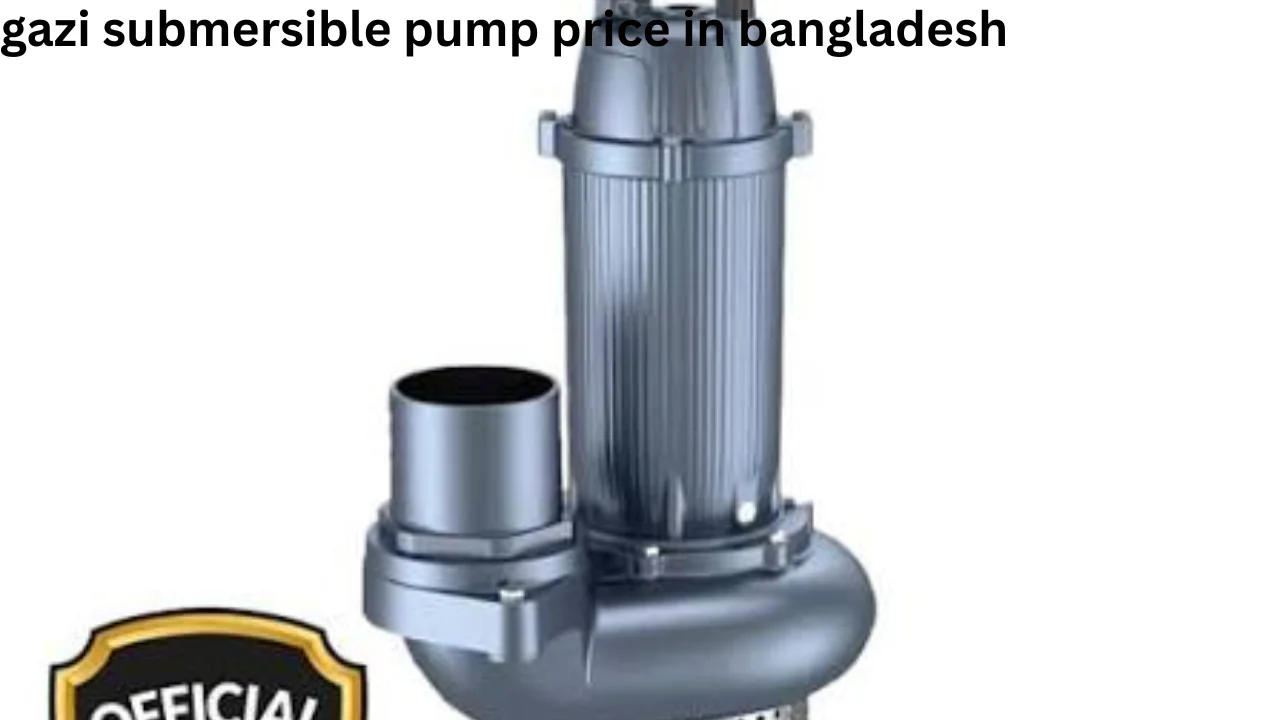
The Gazi submersible pump price in Bangladesh is not one fixed amount. It changes with the pump’s motor power, water-lifting head, flow requirement, borewell diameter, power supply, included accessories, warranty terms, and the seller’s location. The safest way to compare prices is to first identify the exact model and duty required, then request written quotations from authorized or established sellers.
A lower-priced pump can become expensive if it cannot lift water from the required depth, runs dry, uses unsuitable pipework, or has no dependable after-sales support. This guide explains what affects the cost and how to choose a suitable Gazi submersible pump without relying on misleading headline prices.
Must Read: fire extinguisher price in bd
Why there is no single published price for every Gazi submersible pump
Submersible pumps are selected for a specific water source and delivery need. Two pumps that look similar may have very different motors, impellers, cable lengths, head ratings, and discharge capacities. As a result, a price shown for one unit may not apply to another Gazi pump or to a complete installed system.
Retail prices can also move because of import costs, exchange-rate changes, local transport, stock availability, and promotional offers. For an accurate current amount, ask the seller for a quotation that states the full model number, configuration, tax treatment where applicable, and what is included.
What affects Gazi submersible pump price in Bangladesh?

The most meaningful price comparison is between pumps designed to do the same job. These are the main factors that typically determine the final cost.
| Factor | Why it affects price | What to confirm |
|---|---|---|
| Motor power | A higher-power motor is generally built for greater pumping demand. | Rated power and whether it matches the electrical supply. |
| Total head | Pumps designed to push water higher or farther need the appropriate hydraulic performance. | Required vertical lift plus pipe losses. |
| Flow rate | A system needing more water per minute or hour may need a different pump size. | Required discharge at the actual operating head. |
| Pump type and diameter | Models for narrow borewells, open wells, or drainage applications have different designs. | Well diameter, water condition, and intended application. |
| Single-phase or three-phase supply | Electrical configuration affects motor selection and control equipment. | Available voltage, phase, and protection requirements. |
| Materials and construction | Components suited to abrasive water, corrosion exposure, or heavy use may cost more. | Body, impeller, shaft, and seal materials. |
| Included equipment | Cable, control box, starter, float switch, pipe fittings, and installation are often quoted separately. | A complete itemized list. |
| Warranty and service | Clear warranty coverage and local parts support may add value beyond the unit price. | Warranty duration, exclusions, and service location. |
Start with the water source, not the pump price
Before contacting a seller, gather basic information about the site. This prevents the common mistake of buying a motor based only on horsepower or a shopkeeper’s general recommendation.
- Water source: Is it a deep borewell, shallow well, reservoir, pond, tank, sump, or drainage pit?
- Water level: What is the normal and lowest expected water level below ground or below the pump outlet?
- Delivery point: How high must the water reach, and how far will it travel through pipe?
- Required volume: Is water needed for a home, rooftop tank, irrigation line, building supply, fishery, or another use?
- Water quality: Is the water clean, sandy, muddy, or likely to contain solids?
- Power supply: Is reliable single-phase or three-phase electricity available? Are voltage fluctuations common?
- Physical space: What is the borewell casing diameter, and can the pump be lowered and removed safely?
With these details, a dealer or qualified installer can match a pump curve to the required duty point. A pump curve shows how flow changes as lifting head changes. It is more useful than selecting a pump by motor rating alone.
Understanding head, depth, and flow rate
Head is the resistance a pump must overcome to move water. It is often expressed as a height of water. It is not simply the depth of the well.
For example, water may need to be lifted from below ground to a rooftop tank and then pushed through horizontal pipe, bends, valves, and filters. The total requirement includes the vertical lift and friction loss in the pipe system. A long, narrow pipe or many fittings can materially reduce delivered flow.
Flow rate is the amount of water delivered over time. A pump may produce a high flow at a low head but substantially less flow at a higher head. Ask for expected flow at your required total head rather than accepting only a maximum-flow figure.
A correctly sized pump should meet the real demand without being excessively large. Oversizing can lead to unnecessary electricity use, frequent cycling in some systems, high pipe velocity, and added equipment expense. Undersizing may leave a tank filling slowly or fail to supply an irrigation system properly.
Common applications and the pump characteristics they need
Different water jobs call for different equipment. Confirm that the quoted Gazi model is intended for the application rather than assuming every submersible pump is interchangeable.
Domestic water supply and overhead tanks
Homes commonly need a pump that can lift clean water to a storage tank at a dependable rate. The key information is the water level, roof height, pipe route, tank size, and electrical supply. A dry-run protection arrangement may be useful where the source can run low.
Borewell water lifting
Borewell installations need close attention to the casing diameter, static water level, drawdown during pumping, and the depth at which the pump will sit. The pump should remain properly submerged during operation but should not be placed directly on the borewell bottom, where sediment risk may be higher.
Irrigation and agricultural use
Irrigation demand depends on field size, crop method, pipe length, elevation, and the required number of outlets or sprinklers. The needed flow can be much higher than a household requirement. A pump that works for filling a tank may not provide adequate pressure and volume for an irrigation layout.
Drainage, ponds, and dirty water
Not every submersible pump can handle dirty water or solids. A clean-water borewell pump can be damaged by mud, sand, leaves, or fibrous debris. If the purpose is drainage or wastewater handling, specify the expected particle size and water condition before accepting a quotation.
What should be included in a written quotation?
A useful quotation makes it possible to compare offers fairly. Ask for more than a single total price. It should identify the exact equipment and the work covered.
- Full pump model number and motor rating
- Rated head and expected flow range
- Voltage, phase, and frequency requirements
- Pump diameter and discharge outlet size
- Length and type of submersible cable supplied
- Control box, starter, capacitor, overload protection, or other electrical components included
- Pipe, non-return valve, clamps, rope or safety cable, fittings, and delivery charges
- Installation, testing, and commissioning charges, if offered
- Warranty terms, invoice details, and service contact information
Also ask whether the quote covers only the pump and motor or the complete water-lifting system. A low unit price may exclude cable, control gear, delivery, pipework, and installation.
How to compare two pump offers fairly
Do not compare only the largest number in a product name or the cheapest total. Place both quotations side by side and check whether they meet the same required head and flow.
- Write down the required total head, flow, borewell diameter, and power supply.
- Confirm the exact model in each offer.
- Compare delivered flow at the required head, not only maximum head or maximum flow.
- Check which accessories and installation services are included.
- Review warranty coverage and availability of authorized repairs or spare parts in your area.
- Calculate the complete installed cost, including electrical protection and pipework.
If the technical details are unclear, ask the seller to explain them in writing. A reputable supplier should be able to state what conditions the recommended pump is intended to handle.
Installation costs and items buyers often overlook
The purchase price is only one part of the budget. Deep-well and building-water installations may require significant supporting work. The amount depends on the site, so it is better to obtain local estimates than assume a standard installation charge.
Potential extra costs include delivery to the site, borewell inspection, pipe and fittings, electrical wiring, a starter or control panel, earthing, voltage protection, non-return valves, tank controls, labor, and future removal for servicing. In some locations, a lifting arrangement may also be needed for safe installation and removal.
Do not use undersized cable or unsuitable electrical protection simply to reduce the initial cost. Electrical work around water needs to be carried out safely by a competent electrician or installer. Proper earthing and suitable protective devices help reduce electrical and motor-related risks.
How to avoid counterfeit or unsuitable pump listings
Online advertisements and informal marketplace listings can be useful for finding sellers, but they should not be the sole basis for purchase. Product photos may be generic, old, or attached to the wrong model. A price without a model number and performance details is not enough to make a sound decision.
- Ask for a clear photo of the nameplate, packaging, and model identification.
- Match the model number on the invoice to the item delivered.
- Request a proper cash memo or invoice and keep it with the warranty documents.
- Confirm who handles warranty claims and where service is available.
- Be cautious about unusually low prices that omit accessories or have unclear warranty terms.
- Inspect the pump and supplied components before installation where practical.
Only an authorized seller or the manufacturer can confirm current authorized-dealer status, model availability, and warranty conditions. Verify these details directly before paying a deposit or arranging installation.
Maintenance practices that protect the investment
A submersible pump operates out of sight, so performance problems can go unnoticed until the water supply fails. Basic care can reduce avoidable strain on the system.
- Do not run a pump without adequate water unless it is designed and protected for that condition.
- Use the specified electrical supply and have a qualified person investigate repeated tripping, overheating, or voltage issues.
- Keep records of the model, installation depth, invoice, warranty, and service work.
- Watch for reduced flow, unusual cycling, discolored water, or a sharp rise in operating time.
- Have the pump checked if sand or sediment begins appearing in a clean-water supply.
- Do not pull a deep-well pump out by its electrical cable.
Maintenance requirements vary by model and site conditions. Follow the instructions supplied with the particular pump and control equipment rather than using a generic schedule.
Frequently asked questions
How can I get the current price of a Gazi submersible pump?
Contact established Gazi sellers or authorized outlets with the required motor power, head, flow, borewell diameter, and power supply. Request an itemized quotation for the exact model and included accessories.
Is a higher-horsepower submersible pump always better?
No. A larger motor does not automatically provide the right flow at your required head. An oversized or poorly matched pump can cost more to buy and operate while still performing poorly in the actual pipe system.
Does the pump price include installation?
Not always. Pump, cable, control box, pipework, delivery, electrical work, and installation may be separate items. Check the quotation carefully before comparing total costs.
Can one submersible pump be used for both clean water and drainage?
Only if the model is specifically designed for the expected water condition. Clean-water borewell pumps and drainage pumps can have different construction and solids-handling capability.
What information does a seller need to recommend the correct pump?
Provide the source type, well or water depth, lowest water level, delivery height, pipe length and size, desired flow, water quality, borewell diameter, and available electrical supply.
Choosing the right value, not merely the lowest price
The right Gazi submersible pump price in Bangladesh is the cost of a correctly specified, supported system—not just the number attached to a motor. Get quotes for the exact duty required, compare flow at the needed head, include installation and electrical protection in the budget, and keep the invoice and warranty details. That approach gives you a much clearer basis for selecting a pump that can serve the site reliably.